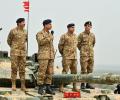
JeM commander Ilyas Kashmiri also said that the Pakistan Army and the jihadis have become one after 25 years of his outfit's struggle.
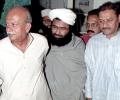
The Pakistan army's Bahawalpur Corps has always had a special significance for India as it keeps an eye on the Jaish e Mohammed, explains Rana Banerji, who headed the Pakistan desk at RA&W.
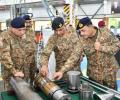
'Pakistan's army has got a streak of democracy. It is more democratic than the country.'
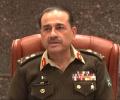
Two important Corps Commands at Multan and Bahawalpur, as also the posts of Adjutant General and Quartermaster General at General Headquarters now stand vacant, reveals Rana Banerji, who headed the Pakistan desk at RA&W.

These transfers can be seen as part of a continuing process on General Asim Munir's part to keep his senior generals happy, notes Rana Banerji, who headed the Pakistan desk at RA&W.
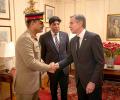
Managing the senior generals has proven to be quite a headache for General Asim Munir, even as he and his team of loyal henchmen labour hard to dispel the sense of unhappiness among the public about the army's overbearing presence and interference in matters 'civilian', notes Rana Banerji, who headed the Pakistan desk at RA&W.

India recognised acts of gallantry by armed forces personnel and senior military officers involved in Operation Sindoor, along with other distinguished service awards, on the eve of the 79th Independence Day.

Mrs Gandhi's power ebbed and peaked with the times. Mr Modi's has almost been constant, barring the few months of hard dip after the 240 seats of 2024, points out Shekhar Gupta.
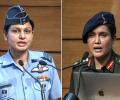
India conducted precision strikes on nine terror targets in Pakistan and Pakistan-Occupied Kashmir, targeting terrorist infrastructure to deter further attacks. The operation, codenamed 'Operation Sindoor', was detailed by two women military officers, Col Sofiya Qureshi and Wing Commander Vyomika Singh, at a press briefing in New Delhi. The officers highlighted the precise nature of the strikes, emphasizing the use of "niche technology weapons" to ensure no collateral damage. The briefing showcased India's military prowess and the growing role of women in the armed forces.
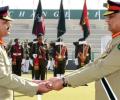
It could be part of a deliberate strategy to heal divisions within and restore the Pakistan army's image, explains Rana Banerji, who headed the Pakistan desk at RA&W.

Lt Gen Zubair Hayat appointed as Chairman of Joint Chief of Staff Committee.
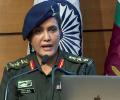
Being a 'fauji' kid, Sofiya Qureshi grew up listening to tales of valour and sacrifice of the army shared by her grandfather, who was a soldier.
What was the aim of Operation Sindoor? Why was the operation halted so soon? asks Lieutenant General Prakash Katoch (retd).

The timing of these transfers, while being projected as routine, is significant in both strategic and political terms, asserts Rana Banerji, who headed the Pakistan desk at the Research and Analysis Wing, India's external intelligence agency.
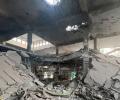
In a strong retaliation to the Pahalgam massacre, India's armed forces early Wednesday destroyed nine terror sites including that of Jaish-e-Mohammad and Lashkar-e-Taiba in Pakistan and Pakistan-occupied Kashmir (PoK) using deep strike missiles in a 25-minute-long 'measured and non-escalatory' mission.

Keeping trusted men in key positions at Lahore, Rawalpindi and Peshawar has become vital for Bajwa, notes Rana Banerji, who headed the Pakistan desk at the Research and Analysis Wing, India's external intelligence agency.
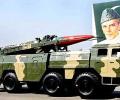
Pakistan military has appointed Lt Gen Zubair Mahmood Hayat as the new chief of the Strategic Plans Division, which manages and secures the country's nuclear arsenal.
Aware of simmering dissensions within the top echelons of the army, Munir has moved slowly in reshuffling senior generals, observes Rana Banerji, who headed the Pakistan desk at RA&W, India's external intelligence agency.

Rana Banerji, who headed the Pakistan desk at the Research and Analysis Wing, India's external intelligence agency, on the latest changes among Pakistan's top generals.
'Given the past practice in the Pakistan army, this delay is most unusual,' notes Rana Banerji, who headed the Pakistan desk at the Research and Analysis Wing, India's external intelligence agency.
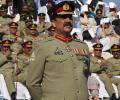
The recent postings and promotions of three-star generals in the Pakistan Army have propelled some of former chief Ashfaq Parvez Kayani's favourites to traditionally important positions

General Qamar Bajwa, his colleagues say, is a firm opponent of extremism and terrorism. He may prove even more forceful in the fight against terrorism than his predecessor, who is credited with launching Operation Zarb-i-Azb, which helped lower the frequency of terrorist attacks.

This will be the fifth time that Prime Minister Sharif will pick the top commander of the country's nearly 550,000 ground troops.

The new ISI chief Lt Gen Mukhtar possesses a vast experience in the field of intelligence and has headed the counter-terrorism wing of the spy agency in Islamabad. He was commissioned in the Armoured Corps regiment in 1983.
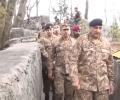
General Bajwa gets inputs from his senior officers, but he has the final word, notes Rana Banerji, who headed the Pakistan desk at the Research and Analysis Wing, India's external intelligence agency.
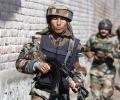
'After General Raheel Sharif took on the Tehrik-e-Taliban Pakistan, some sections of the military establishment may have felt unease as to whether the crackdown could be extended against friendlier 'non-State' actors like the Lashkar-e-Tayiba.'

Nawaz Sharif's appointment of a new army chief will influence India-Pakistan relations

With Pakistan's powerful army chief Gen Ashfaq Parvez Kayani's term coming to an end in November, names of top generals who are likely to succeed him are being discussed in the political circles and in the corridors of power.
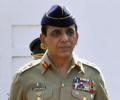
The name of Pakistan Army chief Gen Ashfaq Parvez Kayani's successor will be announced a day before he retires on November 29, Information Minister Pervaiz Rashid said on Friday.

Lt Gen Haroon Aslam of the Pakistan Army on Thursday resigned a day after he was superseded by his two juniors who were made the new army chief and the chairman joint chief of staff committee.

What India has failed to acknowledge is that sub-conventional war is the name of the game and irregular forces have emerged with greater strategic value over conventional and even nuclear forces, and reliance purely on conventional force and diplomacy is grossly inadequate, says Lt Gen Prakash Katoch (retired).

Intermittent blasts and exchange of fire to neutralise two more terrorists continued on Sunday night at Air Force Station in Pathankot, Punjab where four terrorists were killed, seven security men lost their lives and 17 persons were injured in the over 40-hour-long operation.

It said the prime minister of Pakistan has neither chosen to condemn the heinous act nor condoled with the bereaved families.
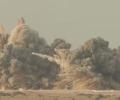
'A conventional war is not in fashion today and not seen as being able to deliver the objective.' 'Perhaps surgical strikes that are deeper, this time not on Pakistan's terrorist facilities, but on Pakistan army facilities.' 'The nation has to be prepared for losses.' 'War is not something that can be pussyfooted around.' 'If we go for limited number of posts in Kashmir, these are very difficult posts to capture and very difficult operations.' 'Be prepared for 200 to 300 killed.'

'If you destroy the assets in Pathankot, you degrade the combat potential of India; you degrade the war potential of India.'
 © 2026 Rediff.com - Advertise with us - Disclaimer - Privacy Policy - Sitemap - Feedback - About us - Terms of use - Grievances